1 Setup
Craps is played on a large casino table with a felt layout showing all the bet areas. Multiple players can bet simultaneously. One player is the "shooter" -- the person rolling the dice. All players may bet on any shooter's roll. Shooters rotate clockwise after they "seven out."
2 Craps Table Layout
The craps table can look overwhelming at first. Once you know where the key bets are located, it becomes straightforward. Use this diagram alongside the bet selection guide below to understand which areas of the table to focus on, and which to avoid.
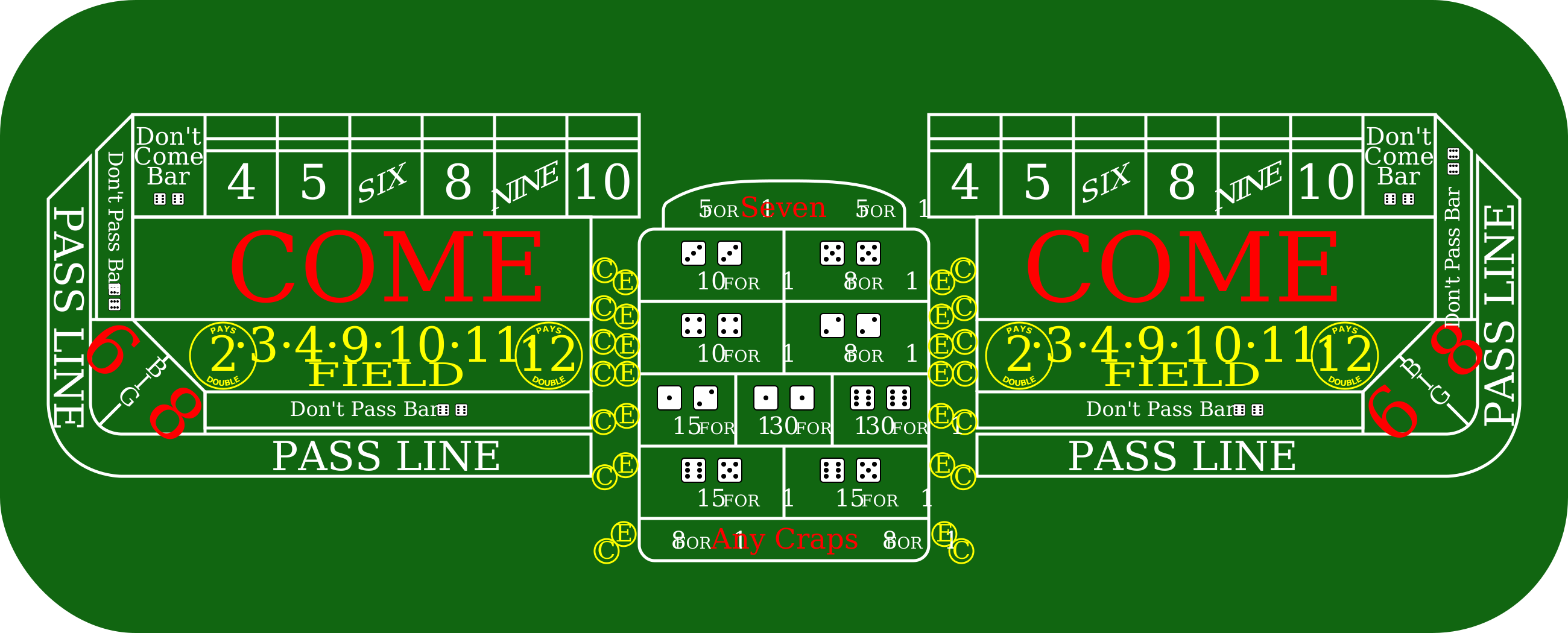
Diagram: Wikimedia Commons, CC BY-SA 4.0. Full table, both ends are identical in a real casino.
Key Areas to Know
- Pass Line, the long strip along the bottom edge. Your primary bet.
- Don't Pass Bar, thin strip above the Pass Line. Betting against the shooter.
- Come / Don't Come, center area. Same as Pass/Don't Pass but placed after the come-out roll.
- Place Bets (4, 5, Six, 8, Nine, 10), the numbered boxes across the middle. Six and 8 are the only acceptable Place bets.
- Field, the large center strip. Popular with beginners; bad odds. Avoid.
- Proposition Bets, center of the table (stickman area). One-roll bets with 9–16% house edge. Never.
- Big 6 / Big 8, corner boxes. Same bet as Place 6/8 but pays even money instead of 7:6. Never use.
One player (the shooter) rolls two dice. On the first roll (come-out): 7 or 11 = Pass Line wins; 2, 3, or 12 = Pass Line loses. Any other number becomes "the Point." The shooter keeps rolling until they hit the Point (Pass Line wins) or roll a 7 (Pass Line loses, shooter changes). Just bet Pass Line and you're playing correctly.
📋 Contents
3 The Come-Out Roll
Each new shooter starts with a "come-out roll." Place a Pass Line bet before this roll.
- 7 or 11: Natural. Pass Line bets win immediately. Another come-out roll follows.
- 2, 3, or 12: Craps. Pass Line bets lose. Another come-out roll follows.
- Any other number (4, 5, 6, 8, 9, 10): This number becomes "the Point." A white puck is placed on that number.
4 Establishing a Point
Once a Point is established, the shooter keeps rolling until one of two things happens:
- The Point is rolled again: Pass Line wins. A new come-out roll begins with the same shooter.
- A 7 is rolled ("seven out"): Pass Line loses. The dice pass to the next shooter. Don't Pass bets win.
5 Key Bets
- Pass Line (house edge ~1.41%): The basic bet. Win on 7/11 come-out; lose on 2/3/12; win if Point repeats; lose on seven-out.
- Don't Pass (house edge ~1.36%): Opposite of Pass Line. You're betting against the shooter. Socially less popular.
- Come bet: Like a Pass Line bet but placed after a Point is established. The next roll is your personal come-out roll.
- Place bets: Bet on 4, 5, 6, 8, 9, or 10 to be rolled before a 7. Pays differently per number (6 and 8 pay 7:6; 5 and 9 pay 7:5; 4 and 10 pay 9:5).
- Proposition bets: Single-roll bets in the center of the table (e.g., Any 7, Hardways). High house edge -- avoid as a beginner.
6 Odds Bets
The single best bet in the casino. Once a Point is established, you can place an additional "Odds" bet behind your Pass Line bet. The Odds bet pays at true mathematical odds with zero house edge.
- Point of 4 or 10: pays 2:1
- Point of 5 or 9: pays 3:2
- Point of 6 or 8: pays 6:5
Casinos typically allow 2x, 3-4-5x, or higher odds. Always take the maximum odds offered -- it lowers the effective house edge on your total Pass Line + Odds bet substantially.
7 Bet Selection Guide: Good Bets vs. Sucker Bets
Craps has the widest range of house edges of any casino game, from 0% on odds bets to over 16% on proposition bets. Knowing which bets to make (and which to avoid entirely) is the entire strategic game.
House Edge by Bet Type
| Bet | House Edge | Verdict | Notes |
|---|---|---|---|
| Free Odds (behind Pass/Come) | 0.00% | ✅ Best bet in casino | True odds, no house edge. Always take maximum odds. |
| Pass Line | 1.41% | ✅ Good | The standard bet. Always pair with odds. |
| Don't Pass Line | 1.36% | ✅ Good | Slightly better than pass. Betting against the shooter. |
| Come Bet | 1.41% | ✅ Good | Same as pass line but placed after come-out roll. |
| Don't Come Bet | 1.36% | ✅ Good | Mirror of don't pass, placed mid-roll. |
| Place 6 or 8 | 1.52% | ⚠️ Acceptable | Best place bets. Bet in multiples of $6. |
| Place 5 or 9 | 4.00% | ⚠️ Mediocre | Much worse than pass+odds. Avoid if possible. |
| Place 4 or 10 | 6.67% | ❌ Bad | Use buy bet instead if table allows ($1 commission). |
| Field Bet | 5.56% | ❌ Bad | Looks like good coverage; actually a trap. |
| Big 6 / Big 8 | 9.09% | ❌ Avoid | Same bet as Place 6/8 but pays even money instead of 7:6. Never use. |
| Hardways (4, 6, 8, 10) | 9–11% | ❌ Avoid | High house edge, slow to resolve. Skip entirely. |
| Any 7 | 16.67% | ❌ Sucker bet | Worst bet on the table. Never. |
| Any Craps | 11.11% | ❌ Avoid | Popular on come-out rolls but terrible value. |
| Proposition bets (Hi-Lo, Yo, etc.) | 11–16% | ❌ Never | One-roll bets with terrible payouts. Casino profit center. |
The Optimal Craps Strategy
Pass Line + Maximum Free Odds = ~0.3% combined house edge
Make a Pass Line bet → wait for a point → take the maximum free odds bet behind it. That's it. Everything else on the table is optional noise at best, a money drain at worst.
If a table allows 3-4-5x odds (common in Las Vegas), your combined effective house edge on pass + max odds drops to approximately 0.374%, lower than any other negative-expectation bet in the casino.
🎲 House Rules
Play Craps your way?
Save your house rules and share a link or QR code — friends can pull them up at the table.