📋 Contents

1 Introduction
Backgammon is the oldest board game still widely played today, and it is the rare game that genuinely rewards both luck and skill in roughly equal measure. At first glance it looks like a dice game where anyone can win. Look closer and you will find a rich strategic landscape studied by mathematicians, computer scientists, and professional players for centuries.
The core premise is a race: two players move 15 checkers each around a board of 24 triangular points, trying to bear all of their pieces off the board before the opponent does the same. Dice provide randomness, but every roll presents real decisions. Which checker to move? Should you leave a blot exposed? Is it time to double the stakes? Over thousands of games, skill dominates. Studies of online play consistently show that top players win far more than 50 percent of their games against average opponents.
A single game takes 20 to 40 minutes. Backgammon is played socially, in clubs, and in high-stakes tournament formats around the world. Learning the rules takes about 10 minutes. Learning to play well takes a lifetime, which is exactly what makes it worth learning.
2 What You Need
- 1 backgammon board, a rectangular board divided into 24 narrow triangles called points, numbered 1 through 24 from each player's perspective
- 15 white checkers and 15 dark (black or brown) checkers
- 2 pairs of six-sided dice, each player rolls their own pair
- 2 dice cups (optional but standard in tournament play)
- 1 doubling cube (optional for casual play, required for serious play), a large die marked 2, 4, 8, 16, 32, 64
Board Orientation
Open the board so the hinge runs left-to-right between you and your opponent. The board is divided by a vertical strip called the bar into two halves of 12 points each. The two halves are further divided conceptually into four quadrants:
- Your home board (also called inner board): the 6 points closest to you on your right side, numbered 1 to 6
- Your outer board: the 6 points closest to you on your left side, numbered 7 to 12
- Opponent's outer board: the 6 points on your opponent's left side (your right, far side), numbered 13 to 18 from your perspective
- Opponent's home board: the 6 points closest to your opponent on their right side, numbered 19 to 24 from your perspective
Points are colored alternately in two contrasting colors. The coloring exists only to make counting easier, it carries no rule significance. By standard convention, the points are numbered 1 to 24 for each player from their own perspective, with point 1 being the starting end of their home board and point 24 being the farthest point (deep in the opponent's home board).
3 Board Setup
The starting position is fixed. From the perspective of either player, the setup looks like this:
- 2 checkers on your 24-point (the opponent's 1-point, deepest in their home board)
- 5 checkers on your 13-point (the opponent's 12-point, their outer board)
- 3 checkers on your 8-point (your outer board)
- 5 checkers on your 6-point (your home board)
The setup is symmetric: White's starting position on one side mirrors Black's starting position on the other. This means that at the start, White has 2 checkers on Black's 1-point, and Black has 2 checkers on White's 1-point. These deep checkers, called the back checkers, must travel the farthest, all the way from point 24 to point 1 and then off the board, a journey of 24 pips each.
Total pips at start: 2×24 + 5×13 + 3×8 + 5×6 = 48 + 65 + 24 + 30 = 167 pips. Both players start with exactly 167 pips to bear off. This symmetry is one of the elegant mathematical properties of backgammon's design.
The Bar and Bearing-Off Area
The bar is the raised ridge dividing the board. Checkers that are hit are placed on the bar and must re-enter the board before their owner can make any other moves. The bearing-off area is off the board entirely, a tray or simply the edge beyond point 1. Borne-off checkers are out of play and can never return.
4 The Goal
Be the first player to bear off all 15 checkers. To bear off, all 15 of your checkers must first be in your home board (points 1 through 6). Then you roll the dice and remove checkers according to the rules in the Bearing Off section.
The movement path is a horseshoe shape: each player's checkers travel from high-numbered points to low-numbered points, crossing the bar, entering the opponent's side, and circling around to their own home board. White moves from 24 toward 1. Black moves from 1 toward 24 (from Black's own perspective, always from 24 toward 1).
The player who bears off all 15 checkers first wins. The margin of the win, whether it is a single game, a gammon, or a backgammon, determines how many points are scored (see Scoring).
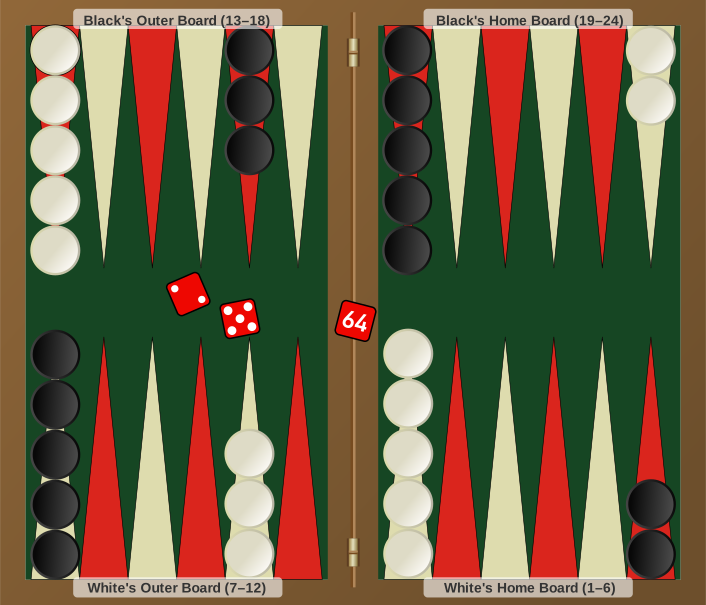
Starting position — White (light): points 6, 8, 13, 24 · Black (dark): points 1, 12, 17, 19 · Via Wikimedia Commons (CC)
5 How to Move
To begin, both players roll one die each. The player with the higher number goes first and uses those two dice as their opening roll (no re-roll if tied, keep rolling until they differ). After that, players alternate turns.
On Your Turn
- Roll both dice.
- Move checkers forward (toward lower-numbered points) by the amounts shown on each die. Each die is a separate move.
- You may use both numbers on one checker, or split them between two different checkers.
- You must use both dice if legally possible. If only one can be used, you must play it. If either die can be used but not both, you must play the higher number.
Doubles
If you roll doubles (both dice show the same number), you move four times that number instead of two. Roll 3-3 and you make four separate moves of 3 each, distributing them among checkers however you like.
Legal Landing Squares
A checker can land on any point that is:
- Empty
- Occupied by one or more of your own checkers
- Occupied by exactly one of the opponent's checkers (this is a blot, you hit it)
You cannot land on a point occupied by two or more of the opponent's checkers. That point is made (also called a prime point), and it is closed to you. There is no limit to how many of your own checkers can stack on a point.
Bar Re-entry
If you have any checkers on the bar, you must enter them before moving any other checkers. Enter by rolling a number corresponding to an open point in the opponent's home board (points 1 to 6 from the opponent's perspective, points 19 to 24 from yours). If all six of those points are closed by the opponent, you cannot move at all and your turn passes.
6 Hitting and the Bar
A blot is a point occupied by exactly one checker. Blots are vulnerable.
When you land on a point containing one of the opponent's checkers, you hit it. The hit checker is placed on the bar. Your checker now occupies the point.
Re-entering from the Bar
A player with one or more checkers on the bar must re-enter all bar checkers before doing anything else. To re-enter, roll the dice and enter your checker onto an open point in the opponent's home board that corresponds to a die number.
Example: White has a checker on the bar. White rolls 4-2. White can enter on Black's 4-point (an open point) and also on Black's 2-point (open). If only Black's 2-point is open, White enters one checker there and cannot use the 4. If both the 4-point and 2-point are closed, White cannot enter at all and loses the entire turn.
Closed Boards and Gammon Pressure
If you hold all six points of your home board (a closed board), any opponent checker sent to the bar is completely trapped, it cannot re-enter until you open a point. This is one of the most powerful positions in backgammon. While the opponent's checker sits on the bar, you advance your other checkers freely. If you then bear off all your checkers before the opponent bears off any, you win a backgammon (3 points) instead of a plain win.
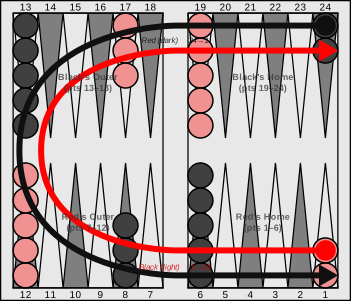
Movement directions — light (red path) and dark (black path) move in opposite directions · Via Wikimedia Commons (CC)
7 Bearing Off
Once all 15 of your checkers are in your home board (points 1 through 6), you may begin bearing off. You cannot bear off a single checker until all 15 are home, if any checker is elsewhere on the board or on the bar, you must bring it home first.
How to Bear Off
- Roll both dice.
- For each die, remove a checker from the corresponding point. Roll a 5, remove a checker from your 5-point.
- If there is no checker on the exact point, move a checker forward (toward lower numbers) instead of bearing off.
- If there is no checker on the exact point AND no checker on a higher-numbered point, bear off the checker on the highest occupied point. Example: Roll a 6, no checker on 6-point, no checker on any point above it, bear off from the highest point that has checkers.
If a checker is hit during bearing off (opponent sends it to the bar), it must re-enter the board and work its way back to the home board before bearing off can resume.
The Race to Zero
Bearing off is a pure race. Mathematically, if you have 15 checkers on your 6-point (the worst starting position for bearing off), you have 90 pips to go. With average dice of about 8.17 pips per roll (using both dice), that is approximately 11 rolls. Your opponent is doing the same calculation, who gets luckier in this final sprint often decides close games.
8 The Doubling Cube
The doubling cube is a large die marked with the numbers 2, 4, 8, 16, 32, and 64. It is not rolled, it is offered as a proposal to increase the stakes of the current game. Without the doubling cube, every game is worth 1 point. With the cube, games can be worth 2, 4, 8, 16, 32, or 64 points.
How to Use the Cube
- Before rolling on your turn, you may offer a double by placing the cube with its "2" face up and saying "double" or "your cube."
- The opponent must either accept (take the cube, agree to play for 2 points) or drop (concede the game immediately for 1 point).
- If accepted, the cube moves to the accepting player's side, they now own the cube and are the only one who can offer the next double.
- The accepting player can later re-double to 4. The original doubler must then accept or drop for 2 points.
When to Double
The key principle: double when your win probability exceeds about 70 to 75 percent. Below that, the risk of turning a probable win into a certain 2-point swing is too high. The precise threshold depends on gammon probability, if you have a significant gammon threat, you should double earlier. The take point (when the opponent should accept) is roughly 25 percent, if your winning chances are below 25 percent, dropping costs less than taking.
Example: If your win probability is 73 percent and your opponent's is 27 percent, doubling is correct. Your opponent's 27 percent win chance (times 2 points = 0.54 expected points for them) is better than dropping for 1 point, so they should take.
The Crawford Rule
In match play, the Crawford rule states: when one player is one point away from winning the match, the doubling cube is not in play for that single game only. This prevents the trailing player from immediately doubling when they have nothing to lose. After the Crawford game, the cube is back in play.
The Beaver
In money play (not match play), a player who is doubled may immediately re-double (to 4) without giving the cube away, retaining ownership of the cube. This is called a beaver. Some games also allow a raccoon (re-double to 8 after a beaver). Beavers are not used in standard tournament match play.
9 Scoring
The size of your win depends on whether your opponent has borne off any checkers and where their checkers are when you complete bearing off all of yours.
| Result | Points | Condition |
|---|---|---|
| Single game | 1 | Opponent has borne off at least one checker |
| Gammon | 2 | Opponent has borne off zero checkers |
| Backgammon | 3 | Opponent has borne off zero checkers AND still has a checker on the bar or in your home board |
All values are multiplied by the current doubling cube value. Win a gammon with the cube at 4, and you score 8 points. This is why gammon threats are so important to the doubling decision.
Gammon Save
Avoiding a gammon is often as important as winning. A player losing a gammon pays double, so even a 30 percent chance of winning might not justify taking a double if the opponent has a 40 percent gammon threat. Gammon probability is a central factor in correct cube handling.
10 Strategy Fundamentals
Backgammon strategy centers on four primary game plans. Recognizing which plan is best in any position, and switching plans as the position changes, is the core skill of the game.
The Running Game
Simply race. Move your checkers forward as fast as possible and avoid contact. The running game is correct when you are significantly ahead in the pip count and there is little risk of being hit. Decisions become purely mathematical: who is ahead, by how much, and is it time to double?
The Blocking Game (Priming)
Build a wall of consecutive made points, a prime, in your opponent's path. A 6-prime (six consecutive made points) is a prison: no checker can escape from behind a 6-prime in one roll. Even a 4-prime or 5-prime creates enormous pressure. Priming games are among the most beautiful in backgammon because both players often have competing primes and the game becomes a timing battle.
The Back Game
Sometimes you fall far behind and cannot win a running race. The back game strategy involves holding two or more anchor points deep in the opponent's home board while the opponent bears off. You hope to hit a blot during their bear-off, then race to catch up. Back games are high-variance: you might win a gammon, or you might lose a gammon. They are usually not chosen voluntarily but are the correct strategy when badly behind.
The Holding Game
Hold one strong anchor point in the opponent's home board (ideally the 20-point, which is their 5-point) and wait for a shot. Holding games are lower-variance than back games and are the most common mid-game strategy. The golden point is the opponent's 5-point (your 20-point). Holding the golden point gives you a launching pad and threatens to hit the opponent's passing checkers.
Blot Safety
A blot more than 6 pips away from the nearest opponent checker is direct-shot safe, no single die can hit it. A blot 7 to 11 away can be hit with combinations of two dice (called an indirect shot). The probability of being hit with a direct shot from 1 pip away is 11/36 (about 31 percent). From 6 pips, it drops to 11/36. From 7, combinations give 6/36 (17 percent). Understanding these probabilities guides whether to leave a blot.
11 Advanced Strategy
Duplication
Duplication is the principle of making the opponent need the same numbers for two different purposes. If your opponent needs a 6 to escape an anchor AND a 6 to cover a blot, only those rolls that achieve both are effective. You want the opponent's good rolls to be as scarce as possible. When choosing between two plays, prefer the one that requires the opponent to roll a specific number for both threats.
Diversification
The opposite of duplication applies to your own rolls: spread your builders and attacking checkers so that many different numbers give you good plays. If all your spare checkers are 6 apart, only doubles help you cover. If they are 2, 3, 4, and 5 apart, almost any roll builds something useful.
Anchor Strategy
Anchors are made points in the opponent's home board. They provide safety (you can never be hit while on an anchor), a launching pad to re-enter after being hit, and a threat to hit the opponent's passing checkers. The best anchors are the 20-point and 21-point. Deep anchors (the 22, 23, and 24 points) are less powerful because they require the opponent's checker to land very close, but they can be valuable in a back game.
Timing in the Back Game
A back game requires precise timing. If you hold two deep anchors but all your other checkers are home before the opponent starts bearing off, you will be forced to break your anchors prematurely. Good timing means your home board stays strong precisely when you need to hit. Managing timing is one of the most difficult advanced skills.
Race vs. Contact Decision Points
Every position is either a race (no more hitting opportunities) or a contact game (checkers can still be hit). The decision of when to run and break contact is critical. Running too early can leave you pip-count behind with no compensation. Running too late means absorbing unnecessary shots. Pip count combined with board strength guides this decision.
12 The Pip Count
The pip count is the total number of pips (points of movement) required to bear off all your checkers. Lower is better. Comparing pip counts tells you who is ahead in the race and by how much.
How to Count Pips
For each of your checkers, multiply its current point number by 1 (each pip forward = 1 pip of progress needed). Sum across all 15 checkers. Starting pip count is 167 for both players.
Example of a simplified position: 5 checkers on your 6-point = 30 pips. 5 checkers on your 4-point = 20 pips. 5 checkers on your 2-point = 10 pips. Total = 60 pips. Your opponent has 5 on 5, 5 on 3, 5 on 1 = 25 + 15 + 5 = 45 pips. Your opponent is ahead by 15 pips.
Shortcuts
Counting precisely every turn is slow. Experienced players use anchor-and-adjust: count a reference position quickly, then add or subtract based on what changed. Another shortcut: count only the checkers that are outside your home board, since home board checkers contribute small values that are easily estimated.
Pip Count and Doubling
In pure races, the Trice formula gives a quick doubling guide: if your pip count is X and your opponent's is Y, double when X/Y is about 0.90 or less (you are 10 percent or more ahead). Take if Y/X is less than about 1.10. These ratios are approximate and adjust for checker distribution (clustered checkers bear off less efficiently than spread ones).
13 Match Play vs. Money Play
Backgammon is played in two main formats: match play and money play. The rules of movement are identical; cube strategy differs significantly.
Match Play
A match is played to a predetermined number of points (7-point, 11-point, and 15-point matches are common in tournaments). The first player to reach the target score wins the match. Score context changes cube decisions dramatically. If you lead a 7-point match 6 to 5, you are one point away from winning, your opponent should use the cube aggressively because every game is worth at least 1 point to them and they must win multiple games anyway.
The Crawford Rule
When one player reaches match point (one point from winning), the very next game is the Crawford game: no cube. After the Crawford game, the cube is back. This rule prevents the trailing player from immediately doubling when they have nothing to lose, the Crawford game must be played straight.
Post-Crawford Play
After the Crawford game, the player behind on score will almost always double immediately at the start of their turn (before rolling). If they are 2 away, a double makes the game worth 2, a win brings them to score. If they are 4 away, they may need to double and re-double.
Money Play
In money play (also called cash play), every game is an independent unit. You win or lose a fixed amount per point. There is no score context. Cube decisions are purely based on game equity without match-score adjustments. Beavers and automatic doubles are common in money games.
The Jacoby Rule
In money play, the Jacoby rule states: gammons and backgammons count only if the cube has been used during the game. This rule encourages cube action by removing the incentive to play on for a gammon without offering a double. Most casual money games use the Jacoby rule; tournaments generally do not.
14 Common Variations
Nackgammon
Invented by Nack Ballard, Nackgammon uses a modified starting position: each player has 2 checkers on the opponent's 1-point (same), but 3 on the opponent's 23-point and only 4 (not 5) on the 13-point and 6-point. This creates more early contact and makes opening play richer and less formulaic.
Acey-Deucey
Popular in the United States Navy and widely played in the eastern Mediterranean. All checkers start off the board and must enter like re-entry from the bar. Rolling 1-2 (acey-deucey) is a special roll: you move 1-2, then pick any double and move it, then roll again. Doubles always result in an extra roll. The result is a faster, more chaotic game with more dramatic swings.
Hypergammon
Each player has only 3 checkers, placed on the 24, 23, and 22 points. The game is much shorter (5 to 10 minutes) and has been fully solved by computer, perfect play has been verified. Hypergammon is used for fast practice and teaching bearing-off skills.
Tavla
The Turkish variant played throughout Turkey, Greece, and the Middle East. Rules are nearly identical to backgammon, but the board orientation is reversed (home board on the left for some players) and the initial setup is slightly different in some regional versions. Tavla is played without a doubling cube in most casual settings.
15 Wrong House Rules (Common Mistakes)
Backgammon has been passed down through social play for generations, and several wrong rules have become widespread. Here are the most common errors:
"You Must Use Both Dice"
Wrong. You must use both dice if legally possible. If only one die can be played, play it. If either die can be played but not both, you must play the higher die if possible, then the lower if possible. Forfeiting an unusable die is correct and required.
"Doubles Means Roll Again"
Wrong in standard backgammon. Rolling doubles gives you four moves of that number, not an extra roll. The "roll again" rule exists in Acey-Deucey but not in backgammon.
"You Can't Double Early in the Game"
Wrong. You may offer a double on your very first turn if you have a positional or pip-count advantage. Automatic doubles (agreed before the game to start the cube at 2 if both players roll the same number) are a house rule variant but not standard.
"Gammon Only Counts as 1 Point"
Wrong. A gammon is worth 2 points (or 2 times the cube value). A backgammon is worth 3 points. These multiplied values have been standard since the game's modern rules were formalized in the early 20th century.
"You Can Move Backward If Needed"
Wrong. Checkers always move in one direction only, toward the home board. There is no backward movement in backgammon under any circumstances.
"If You Touch It You Must Move It"
Not a rule in standard backgammon. You may pick up a checker, reconsider, and put it back, until you have completed a move and taken your hand away. Tournament rules may differ, but casual play has no touch-move rule.
16 History of Backgammon
Backgammon is among the oldest known board games in the world. The basic concept of racing pieces along a track using dice has appeared in nearly every human civilization.
Ancient Origins
The Royal Game of Ur, played in Mesopotamia around 3000 BC, is often cited as an ancestor. Archaeological excavations at Ur (in present-day Iraq) found boards, pieces, and tetrahedral dice. The Egyptian game Senet, depicted on tomb paintings from around 3500 BC, also involved racing pieces. Whether these games share a direct lineage with modern backgammon or are parallel inventions is still debated by game historians.
Roman Tabula
The Roman game Tabula (meaning "board") closely resembles modern backgammon. Played in the Roman Empire from the 1st century AD, Tabula used three dice, 15 pieces per player, and 24 points. Emperor Claudius was reportedly an enthusiastic player and wrote a book about the game (now lost). A Tabula board was found among the ruins of Pompeii.
Medieval Tables
Throughout medieval Europe, the game was known as "Tables" and appeared in countless variants. The Crusades spread Tables from the Middle East to Europe. Alfonso X of Castile's 1283 manuscript "Libro de los juegos" (Book of Games) includes detailed descriptions of Tables variants. The game was popular in English taverns and was periodically banned by monarchs who felt it distracted soldiers and workers from more productive pursuits.
The Name "Backgammon"
The English name appears first in 1645. The most widely accepted etymology derives from the Welsh words "back" (small) and "gammon" (game or battle), though some scholars prefer an Old English derivation from "baec" (back) and "gamen" (game), referencing the return of captured pieces from the bar.
The Modern Game
The doubling cube was introduced in New York City around 1920, transforming backgammon from a pleasant parlor game into a high-stakes intellectual contest. The cube introduced a layer of pure strategic decision-making, separate from the dice and movement, that gave skilled players a significant advantage over less skilled ones.
Oswald Jacoby, the American mathematician and card player, became one of backgammon's great champions in the 1960s and helped organize the first World Backgammon Championship in Las Vegas in 1964. His books on backgammon and game theory raised the intellectual profile of the game considerably.
The Computer Revolution
In 1992, Gerald Tesauro at IBM created TD-Gammon, a neural network trained by playing millions of games against itself using temporal-difference learning. TD-Gammon reached near-world-champion strength and fundamentally changed how experts understood the game. Positions that human experts considered clearly correct were revealed to be errors; positions thought to be mistakes were shown to be optimal. GNU Backgammon (open source) and XG (eXtreme Gammon) followed, and today world-class AI plays far beyond any human. Top players now use these programs to analyze every game and study their mistakes.
17 Frequently Asked Questions
Can you move backwards in backgammon?
No. Checkers always move forward, toward your home board and eventually off the board. There is no backward movement under any circumstances.
What happens if you can't move?
If no legal move is possible (all relevant points are closed by the opponent), you lose your turn entirely. This most often happens when you have a checker on the bar and all six entry points in the opponent's home board are made.
How long does a game of backgammon take?
A single game typically takes 20 to 40 minutes. Short games where one player dominates can finish in 10 minutes. Complex contact games can take an hour. Match play (multiple games) takes 1 to 3 hours for a 7-point match.
Is backgammon mostly luck or skill?
Both, in meaningful proportions. Any single game has significant luck, dice can give one player a huge advantage. Over a series of games, skill dominates clearly. Top players win over 60 percent of games against average players, and the variance compresses further in match play. The skill-to-luck ratio is often compared to poker: luck matters in any hand, but over a session, the better player wins.
What is the doubling cube?
The doubling cube is a large die marked 2, 4, 8, 16, 32, 64. Before rolling on your turn, you may offer to double the current game value. Your opponent must accept (and own the cube) or concede the game. It adds a powerful strategic layer separate from movement.
What is a gammon?
A gammon occurs when you bear off all 15 of your checkers before your opponent bears off any of theirs. It is worth double the normal game value (2 points without the cube, or 2 times the cube value with it).
Can both dice numbers go to the same checker?
Yes. If you roll 3-5, you can move one checker 3 points forward and then 5 more points (landing on two separate intermediate and final points, both of which must be legally open).
What if I can only use one die?
You must use it. If you can use either die but not both, you must play the higher number. Playing zero dice is never allowed unless literally no move is possible.
How do you win a backgammon match?
Reach the target score first. In a 7-point match, the first player to accumulate 7 or more points wins. Points come from games: 1 for a win, 2 for a gammon, 3 for a backgammon, all multiplied by the cube value.
What is the Crawford rule?
In match play, when one player is exactly one point from winning, the immediately following game is played without the doubling cube. This prevents the losing player from doubling immediately with no risk. After the Crawford game, the cube is back in play.
What is a prime in backgammon?
A prime is a series of consecutive made points (each point held by 2 or more of your checkers). A 6-prime is six consecutive made points and is impassable by any checker behind it in a single roll. Primes are among the most powerful structures in backgammon.
What is the golden point?
The golden point is your opponent's 5-point (your 20-point). It is considered the most valuable single point to control in backgammon because it sits deep in the opponent's home board, gives you a powerful anchor, and threatens to hit checkers trying to pass.
🎲 House Rules
Play Backgammon your way?
Save your house rules and share a link or QR code — friends can pull them up at the table.