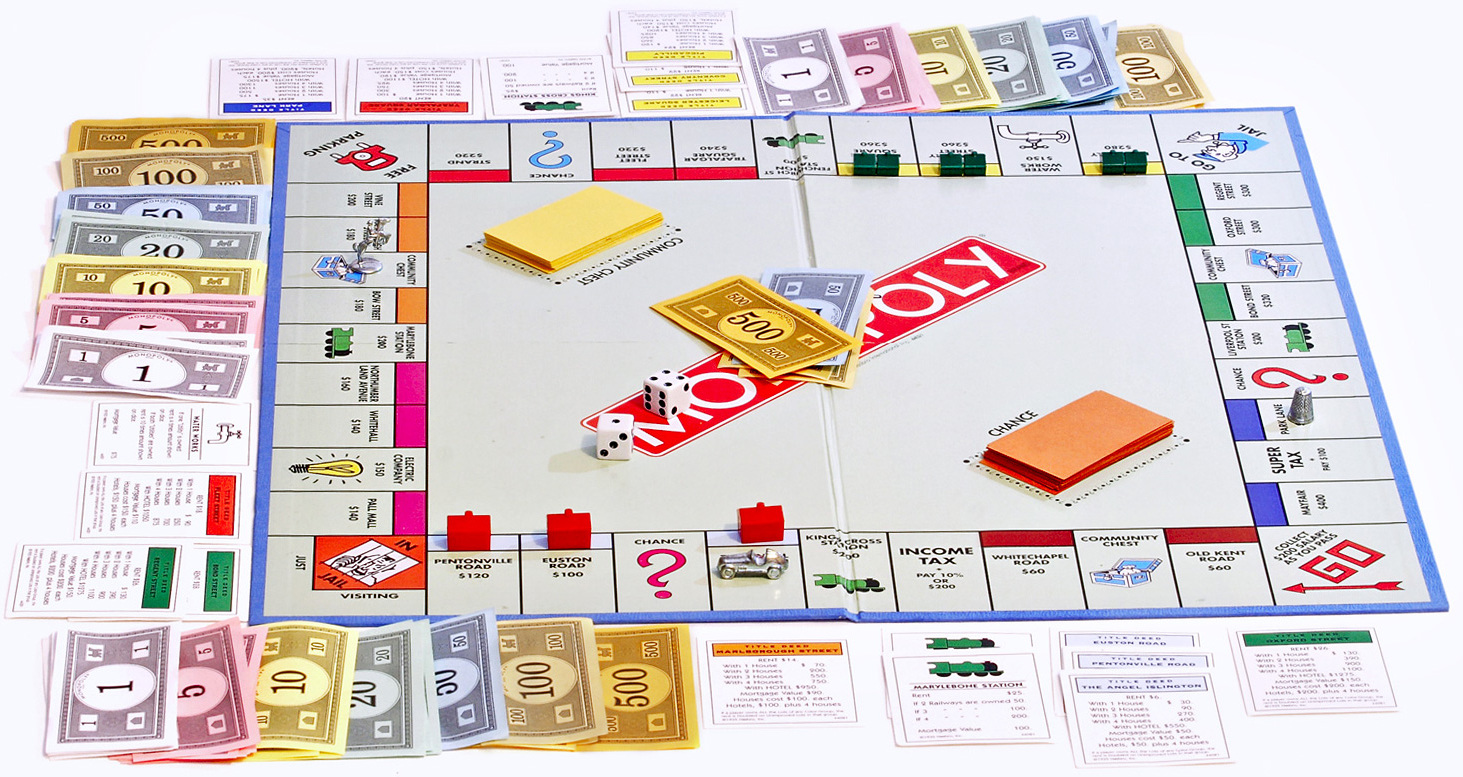
📋 Contents
1 Setup
Each player receives $1,500: two $500s, two $100s, two $50s, six $20s, five $10s, five $5s, and five $1s. Place all properties, railroads, and utilities on the board. Each player chooses a token and places it on Go. The youngest player goes first.
2 Taking Your Turn
- Roll both dice and move your token clockwise the indicated number of spaces.
- Complete the action of the space you land on.
- If you rolled doubles, take another turn after completing your action. Roll doubles three times in a row and go directly to Jail.
Passing Go: Collect $200 every time you pass or land on Go.
3 Buying Property
When you land on an unowned property, you may buy it from the bank at the listed price. If you buy it, take the title deed card. If you choose not to buy, the property immediately goes to auction (see below), this is official Monopoly rules that most players skip.
You may buy properties on your very first turn, there is no "one lap first" restriction in the official rules.
4 Auctions
Any time a player declines to buy a property at the listed price, the Banker immediately auctions it to all players, starting at $1. All players, including the one who declined, may bid. The highest bidder buys it. Auctions keep the game moving and prevent anyone from simply "parking" on valuable properties without consequence.
Auctions are official rules, not a variant. Skipping them is the house rule.
5 Collecting Rent
When another player lands on your property, they must pay rent. Rent amounts are printed on the title deed. Important rent rules:
- Monopoly bonus: If you own all properties in a color group (a monopoly), rent on unimproved properties doubles.
- Railroads: Rent scales with ownership, 1 railroad: $25; 2: $50; 3: $100; 4: $200.
- Utilities: If you own one utility, rent = dice roll × 4. If you own both, rent = dice roll × 10.
- You must ask for rent before the next player rolls. If you miss it, no rent is owed.
- You can collect rent while in jail.
6 Building Houses & Hotels
Once you own all properties in a color group, you may build houses and hotels on your turn (before or after rolling).
- Buy houses from the bank at the price shown on the title deed.
- Houses must be built evenly, you may not put a second house on any property until all others in the group have one house. The same applies for 2→3 and 3→4 houses.
- After placing 4 houses on each property in the group, you may buy a hotel. The 4 houses return to the bank. Each hotel replaces all 4 houses on one property.
- If the bank runs out of houses, no more may be built until some are returned.
- Sell houses/hotels back to the bank at half price any time.
7 Jail
Going to Jail: Land on "Go to Jail," draw a card that says go to jail, or roll doubles three times in a row. Move directly to Jail, do not pass Go, do not collect $200.
Getting out of Jail:
- Roll doubles on any of your next three turns
- Pay $50 fine before rolling on your 1st or 2nd turn in jail
- Use a "Get Out of Jail Free" card
- After three failed rolls, pay $50 and move based on your third roll
In jail: You may still collect rent, build houses, mortgage property, and trade. Being in jail does not suspend your economic activity.
8 Chance & Community Chest
Draw the top card when you land on these spaces. Follow the instructions and return the card to the bottom of the deck, except "Get Out of Jail Free," which you keep until used or sold.
9 Mortgaging
Mortgage a property to the bank for half its listed price. Turn the deed face-down. No rent can be collected on mortgaged properties. You must sell all houses and hotels on a color group before mortgaging any property in that group.
To unmortgage: pay the bank the mortgage value plus 10% interest. Until unmortgaged, the property generates no income.
Mortgaged properties can be traded. The new owner must immediately pay 10% interest, then has the option to unmortgage or leave it mortgaged (paying another 10% when they eventually unmortgage).
10 Trading
Players may trade properties, cash, and "Get Out of Jail Free" cards at any time (on your turn, before or after rolling; during other players' turns by mutual agreement). Trades may include future rent immunity ("You can land on my Boardwalk for free twice"), these are binding agreements, but Monopoly has no official enforcement mechanism. Honor system applies.
11 Bankruptcy
If you cannot pay a debt (rent, tax, fine) even after mortgaging and selling all your assets, you are bankrupt.
- If bankrupt to another player: give that player all your assets, including title deeds (at face value, not mortgage value, the receiving player must immediately handle unmortgaging costs).
- If bankrupt to the bank: return all assets to the bank; properties go back up for auction.
Bankrupt players are eliminated. The game ends when all but one player are bankrupt, or by agreement when time runs short.
12 House Rules That Are Actually Wrong
These common house rules are not in the official Monopoly rulebook, and most of them make the game longer and less balanced:
- Free Parking jackpot, putting fines and taxes on Free Parking and collecting them when you land there. This keeps money in the game too long and extends playtime significantly.
- No buying on the first lap, there's no such rule. You can buy from turn 1.
- Skipping auctions, if you don't buy, it must be auctioned. Skipping auctions is the single biggest reason Monopoly games drag on forever.
- Landing on Go = $400, landing on Go pays $200, same as passing it.
- Loans from the bank, not allowed in official rules; mortgage your properties instead.
13 Property Groups and Colors
The Monopoly board has 22 properties organized into 8 color groups. Owning all properties in a color group gives you a monopoly and unlocks house-building. Here are all groups with their purchase prices and base rents:
| Color | Properties | Price Range | 1-House Rent |
|---|---|---|---|
| Brown | Mediterranean Ave, Baltic Ave | $60-$80 | $10 |
| Light Blue | Oriental, Vermont, Connecticut Aves | $100-$120 | $30 |
| Pink | St. Charles, States, Virginia Aves | $140-$160 | $50 |
| Orange | St. James, Tennessee, New York Aves | $180-$200 | $70 |
| Red | Kentucky, Indiana, Illinois Aves | $220-$240 | $90 |
| Yellow | Atlantic, Ventnor Aves, Marvin Gardens | $260-$280 | $110 |
| Green | Pacific, North Carolina, Pennsylvania Aves | $300-$320 | $130 |
| Dark Blue | Park Place, Boardwalk | $350-$400 | $175 |
Railroads: Reading, Pennsylvania, B&O, Short Line, $200 each. Utilities: Electric Company ($150), Water Works ($150).
14 Best Properties: The Math
Experienced Monopoly players know that orange and red properties offer the best return on investment. Here is why:
Orange Properties (St. James, Tennessee, New York)
The orange group is statistically the most landed-on color group in the game. This happens because of Jail: players frequently exit Jail and then roll 6 to 9 squares, landing squarely in the orange zone (6 to 9 squares from Jail = orange territory). With 3 houses, New York Avenue pays $500 rent for a $200 investment per house. Building to 3 houses on oranges is considered the optimal early-game strategy.
Red Properties (Kentucky, Indiana, Illinois)
The reds are the second-most-landed group and have slightly higher face rent than oranges. Illinois Avenue is the single most landed-on property on the entire board (counting Jail exits and the Illinois-GO corridor). With a hotel, Illinois pays $1,050 on a $150 house cost.
Dark Blue (Park Place and Boardwalk)
High rent but expensive to build and rarely landed on. Boardwalk with a hotel costs $400 purchase + 5 houses at $200 each = $1,400 total investment, paying $2,000 rent. That is a strong ratio, but landing frequency is low, only about 3% per roll. In long games, dark blue wins; in shorter games, oranges and reds are more reliable income.
House Scarcity Rule
The game comes with only 32 houses total. When they run out, no more can be built until houses are returned (by selling or upgrading to hotels). This creates a strategic resource: if you and an opponent both want to build, the first to buy 32 houses can starve the opponent of development. This is called a "housing shortage" and is a legitimate competitive strategy.
15 Jail Strategy
Jail is not just a punishment, it is a strategic tool, especially in the late game.
Early Game: Get Out Fast
In the early game (before most properties are developed), you want to be moving around the board. The more laps you take, the more chances you have to buy properties. Pay the $50 fine immediately on your first turn in jail during the early game to maximize board time.
Late Game: Stay In
Once the board is covered in houses and hotels, leaving jail becomes dangerous. Every move risks landing on an opponent's developed property. If you are in jail and opponents have hotels on Boardwalk, Park Place, or the reds, stay in jail as long as possible. Roll for doubles three times (you will still move on the third roll), collect rent while inside, and pay the $50 only as a last resort.
Get Out of Jail Free Cards
These are worth real money in the late game. Hold one until you need it. In early trading, opponents may offer cash for your GOJF card. Its strategic value is typically $50 to $75 depending on the game state.
16 Mortgage Rules with Exact Math
Mortgaging is the official way to raise emergency cash. The rules:
- Mortgage value = exactly half the purchase price. Mediterranean Avenue ($60) mortgages for $30. Boardwalk ($400) mortgages for $200.
- Flip the title deed face-down. No rent may be collected on that property.
- To unmortgage: pay the bank the mortgage value PLUS 10% interest. Example: Mediterranean costs $30 + $3 = $33 to unmortgage. Boardwalk costs $200 + $20 = $220.
- You MUST sell all houses and hotels on a color group before mortgaging any property in that group (houses sell at half price: a $50 house returns $25).
- You CAN trade mortgaged properties. The new owner pays 10% of the mortgage value immediately upon receiving it ($3 for Mediterranean), then pays the full unmortgage cost ($33) to lift the mortgage later. If they choose to lift it immediately, they pay 10% on receipt plus the full cost, for a total of $36.
17 Speed Die Variant
The Speed Die is an optional third die included in many modern Monopoly editions to reduce game time. Rules:
- Do not use the Speed Die until every player has completed at least one full trip around the board.
- The Speed Die has faces: 1, 2, 3, and two "Mr. Monopoly" faces and one Bus face.
- Add the Speed Die result to your normal movement. If you roll a 1, 2, or 3 on the Speed Die, add that to your total movement.
- Bus face: move to either of the next two special squares ahead of you (Chance, Community Chest, Tax, Railroad, or Utility), your choice.
- Mr. Monopoly face: move as normal using the two standard dice. If there is any unowned property on the board, advance to the nearest unowned property after landing. If all properties are owned, advance to the nearest property you owe rent on. (If you pass Go during this advance, collect $200.)
18 Trading Strategy
Trading is where Monopoly is actually won. The official rules allow trading at any time, and smart traders control the game.
Always Complete Monopolies
The game does not progress until someone has a monopoly. If you hold the third property of someone else's color group, you have leverage. Use it to negotiate for the monopoly you need, plus cash or favorable rent agreements.
Never Give a Monopoly for Nothing
When you trade someone their third property (completing their monopoly), charge appropriately. Ask for cash, a reciprocal monopoly, or rent forgiveness clauses. A completed monopoly is worth far more than the sum of its individual properties.
Cash is Undervalued
Players often overvalue properties and undervalue cash. Early in the game, liquid cash lets you buy more properties and build faster. A property with decent rent potential is often worth more in cash equivalent than players expect.
Trade Across Color Groups
Try to ensure that when you complete a monopoly, your opponent does not receive one of equal or greater value in return. Orange for brown is fine; orange for red or green is dangerous.
19 History of Monopoly
The origins of Monopoly trace back to 1903, when Lizzie Magie, a progressive activist, patented "The Landlord's Game." Her game was designed to illustrate the dangers of land monopolism and the economic theories of Henry George. It featured the same circular board concept, properties, railroads, and a "Go to Jail" space. The game spread through political and intellectual circles, with handmade copies circulating across the eastern United States.
In the 1920s and early 1930s, many regional versions of the game emerged. Charles Darrow, an unemployed salesman from Philadelphia, learned a version of the game from friends, made his own set based on Atlantic City street names, and sold it to Parker Brothers in 1935. He became the first millionaire game designer in history. The story of Darrow as "inventor" was promoted heavily by Parker Brothers, Lizzie Magie's contribution was largely obscured for decades.
Parker Brothers bought Magie's patent for $500 (with no royalties). Monopoly became the best-selling board game in history, eventually sold to Hasbro in 1991. Over 500 million people have played Monopoly, and it has been produced in more than 43 languages and 111 countries.
20 Frequently Asked Questions
Do you collect $200 when you land on Go, or only when you pass it?
You collect $200 either way, whether you pass Go or land directly on it. Some house rules say landing on Go pays $400, that is not official.
Can you build hotels without going through all 4 houses?
No. You must have 4 houses on a property before purchasing a hotel. There is no shortcut to hotels.
Can you buy houses on your first turn?
You can only build houses once you own a complete color group. You cannot buy a full group on turn one, so no, but the moment you own all properties in a group, you may build on any subsequent turn.
Can you collect rent while in Jail?
Yes. Jail does not suspend your economic activity. You may collect rent, build houses, trade, and mortgage while in Jail.
What if no one can afford to buy at auction?
If an auctioned property receives no bids, it remains with the bank and is auctioned again the next time a player lands on it and declines to buy.
Can two players trade future rent immunity?
Yes. "Free landing" agreements are allowed in official rules. They are binding by honor, Monopoly has no enforcement mechanism. Players who cheat on trade agreements can be sanctioned by other players refusing to trade with them.
What happens when the bank runs out of money?
Use paper, coins, or any substitute to represent money. The bank never officially runs out, it can use any denomination to represent what it owes.
Can you mortgage a property to pay rent?
Yes. You may mortgage on your turn at any time. However, you cannot mortgage during another player's turn simply because you are about to land on their property. Once you land and owe rent, you settle your debt by mortgaging assets in sequence.
Must houses be built evenly across a color group?
Yes. You cannot place a second house on any property in a group until every property in the group has one house. Building must proceed evenly: all properties reach 1 house before any goes to 2, all reach 2 before any goes to 3, and so on.
What happens to a bankrupt player's mortgaged properties?
If bankrupt to another player, the mortgaged properties go to that player (who pays 10% interest on receipt). If bankrupt to the bank, they return to the bank and are auctioned unmortgaged the next time someone lands on them.
Is the Free Parking jackpot an official rule?
No. Putting fines, taxes, and penalties under Free Parking and paying them to whoever lands there is a house rule, not official. It injects more money into the game, extends play time, and reduces the economic tension that makes Monopoly interesting.
Can you build houses before landing on all your properties?
You may build once you own all properties in a color group regardless of where your token is. You do not need to land on the property to build on it.
🎲 House Rules
Play Monopoly your way?
Save your house rules and share a link or QR code — friends can pull them up at the table.